
Manage WI-FI
This service outsources the design, implementation, optimization, and ongoing maintenance of an organization’s wireless network to a specialized provider. The goal is to provide reliable, high-speed, and secure Wi-Fi connectivity for all users and devices, both indoors and outdoors, freeing internal staff from these complexities.
📡 What Does the Service Cover?
The managed Wi-Fi service covers all aspects necessary for the wireless network to function as a critical, uninterrupted business service.
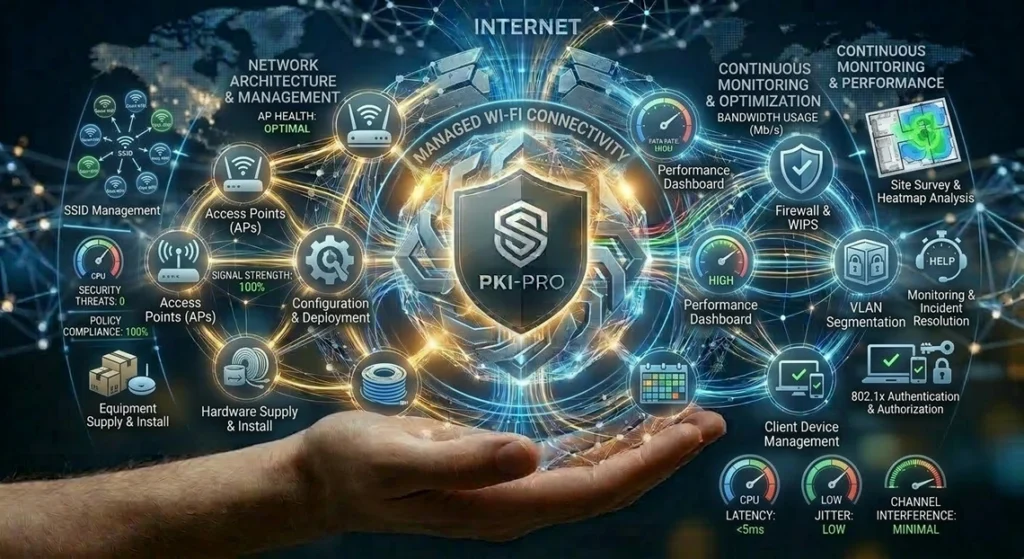
- Design and Site Survey: The service begins with a site survey, which can be predictive (using software) or physical (with on-site measurement equipment). The office layout, construction materials, and user density are analyzed to determine the optimal placement of Access Points (APs) , ensuring complete coverage without dead zones.
- Hardware Supply and Installation: The provider selects the appropriate hardware (access points, controllers, PoE switches) based on the client’s needs. They handle the physical installation, structured cabling, and initial configuration of the devices.
- SSID Configuration and Management: The different required Wi-Fi networks (SSIDs) are created and managed. For example, a secure corporate network for employees, a guest network with limited internet access, and separate networks for IoT devices or VoIP. Quality of Service (QoS) policies are applied to prioritize critical traffic, such as video calls.
- Security and Access Control: The most advanced security protocols are implemented, such as WPA3, and authentication systems like 802.1X (which requires user credentials to connect). Specific firewalls for the Wi-Fi network and Wireless Intrusion Prevention/Detection Systems (WIPS/WIDS) are also managed to detect and mitigate threats like rogue access points.
- Continuous Monitoring and Optimization: The service monitors the Wi-Fi network 24/7. Metrics such as AP load, signal strength, Signal-to-Noise Ratio (SNR), channel utilization, and per-user throughput are tracked. This allows for dynamic adjustments (like transmit power or channel selection) to automatically optimize performance.
- Support and Incident Resolution: Users have a point of contact to report Wi-Fi connectivity issues. The provider is responsible for diagnosing and resolving incidents, either remotely or with an on-site visit if necessary.
⚙️ How Does It Work Technically?
The operation is based on cloud-based centralized management systems and automatic optimization algorithms to ensure a consistent and high-quality user experience.
- Cloud-Managed Architecture: Most modern managed Wi-Fi services utilize a cloud-based architecture (such as Cisco Meraki, Aruba Central, or Juniper Mist). The Access Points (APs) connect to a cloud controller, not a local physical one. This allows the provider’s administrators to configure, monitor, and troubleshoot the entire fleet of APs from a single, centralized web console, no matter where they are located.
- Zero-Touch Provisioning: When a new access point is installed, it automatically connects to the internet, locates the cloud controller, downloads its configuration, and joins the network without needing a technician to manually configure it on-site. This greatly simplifies and accelerates deployments and expansions.
- Automatic Radio Resource Management (RRM) : The cloud controller uses intelligent algorithms to automatically manage the radio frequency spectrum. It dynamically adjusts the APs’ transmit power and assigns channels (e.g., 20, 40, or 80 MHz channels in the 5 GHz band) to avoid interference between neighboring APs and optimize coverage and capacity in real-time, adapting to changes in the environment.
- Spectrum Analysis and Threat Detection: Modern APs can act as network sensors. They continuously scan the spectrum for interference (from microwaves, other wireless devices) and security threats. If they detect an unauthorized access point (rogue AP) or a wireless Denial of Service (DoS) attack, they send an immediate alert to the dashboard so the provider can take action.
- Quality of Service (QoS) and Application Policies: The service allows for the definition of granular QoS policies. For example, it can be configured so that VoIP and video conferencing traffic is always prioritized over web browsing or file downloads. This is applied consistently across all APs from the cloud, ensuring a good experience for critical applications.
In summary, the “Managed Wi-Fi” service turns the wireless network into a reliable, secure, and high-performance business asset. The provider acts as a team of wireless networking experts who design, implement, and continuously optimize connectivity, allowing users to move and work without worrying about the quality or security of their connection.